
EPALE MOOC: Artificial Intelligence, Robots and HR

Author: Dr Adrienn Hadady-Lukács, PhD, University of Szeged, Faculty of Law and Political Sciences, Institute of Labour Relations and Social Security Training
This is a translated article. Original language is Hungarian. The translation was prepared on behalf of the Hungarian EPALE National Support Service.
Today, AI is increasingly present in the workplace, raising the question of what kind of impact this has on employers’ rights and on work itself. How will AI transform the workplaces of the 21st century? In this chapter, we are going to discuss the way algorithmic management has reformed employer decision-making. Next, we will briefly touch upon the subject of applying AI in the ‘position’ of specific workers. Finally, the chapter concludes with a discussion of the relevant legal challenges, in particular the right to equal treatment and the right to the protection of personal data.
1. Introduction
The use of AI-based technology increasingly permeates the world of work, raising a number of labour law issues. In the context of labour law, two broad groups of issues can be distinguished, related to the quantity and quality of work. On the one hand, the question arises whether AI and robots are indeed taking away jobs from humans or not. On the other hand, there is a discussion about the impact of AI on work itself (the very subject of this chapter). How will workers do their work, in what kind of environment?[1] This is the issue explored in this chapter.
2. Algorithmic decision-making in the workplace
One of the most important applications of AI in the workplace is its use in an employer role. In labour law, the employer has certain rights, such as to control, direct, instruct and discipline, the effective exercise of which is inseparable from the employer’s decision-making. These employer decisions are diverse and permeate everyday working life. For example, an employer can decide whom to hire for a particular position, whom to promote, which tasks to assign to which employee, etc. The novelty brought by automation and AI is that it has become possible for an employer to outsource some or all of these decisions to an algorithm.
Automated decision-making means that a system uses technological tools to make the decision without human intervention.[2] Automated decision-making refers to the automatic execution of rules given by humans (rule-based algorithm) or the use of (quasi) autonomous systems based on AI (learning algorithm).[3]
Automated decision-making systems have become an integral part of everyday life. Automated decision-making is at work when a spam filter forwards an email to the junk mail folder or when a personalised online advertisement appears on a user’s device.
It is also necessary to distinguish between automated decision support systems and supported decision support systems. While automated decision-making systems make decisions autonomously, without the involvement of a human decision-maker, supported decision-making systems only support and complement human decision-making.[4] However, a 2022 research has shown that nowadays, fully automatic (AI-based) decision-making is not (yet?) widespread. In practice, the use of assisted decision-making is more typical, i.e. even though the AI contributes to the decision, but it is the human decision-maker who usually makes the final decision.
Another phenomenon to discuss is automation bias. In the case of supported decision-making systems, human decision-makers often rely excessively on the results of machine decision-making, since they tend to consider it infallible, even when it contradicts their own beliefs or knowledge.[5] An example is when someone blindly follows the instructions of a GPS navigation system and finds themselves at a forbidden or dangerous place – for example, driving their car into a river.
A specific form of automated decision-making in labour law is the so-called algorithmic management. Algorithmic management is ‘the use of computer-programmed procedures in an organisation to coordinate the workforce’ [6]; that is, essentially the digitalisation and automation of the powers vested in the employer. In other words, the decisions that the employer is entitled to make are made using an algorithm. The application of automated decision-making in the workplace may have several implications. It can be used for recruitment and selection, performance measurement and evaluation, or even career path planning, among other things.[7]
In practice, it is often the case that algorithmic systems and HR software help employers in making decisions. An example is the Tengai software. Tengai’s automated software simplifies recruitment by guiding candidates through a structured interview and collecting relevant data. This enables the HR manager to assess the professional skills of candidates and compare them with each other and with the expected requirements.
An example of algorithmic control of work is the monitoring system used by Amazon in its warehouses. Workers were issued scanners that tracked their periods of inactivity and the duration of each work phase (e.g. loading onto shelves). This raises serious data protection concerns. For example, the French data protection authority fined the local Amazon in 2024 because its control system did not comply with data protection requirements.
Another example of modern recruitment and selection is HireVue. HireVue’s enterprise-wide recruitment platform is essentially a full-scale recruitment and selection service. The software includes video interviewing and staff surveys, as well as automation through artificial intelligence. According to the company’s website, HireVue makes recruitment faster, fairer and more flexible by combining video interviewing with AI technology.
An example of a fully automated decision-making system is the so-called platform work. As defined by Eurofound, platform work is “a form of employment that uses an online platform to enable organisations or individuals to acccess other organisations or individuals to solve problems or to provide services in exchange for payment”. Platform work includes, among others, food delivery couriers (e.g. Wolt, Foodora) and Uber drivers. Platform work is completely under algorithmic ‘control’, since task assignment, payroll, user account suspension, and so on are all automatic, meaning that platform workers have no contact with a human being and communicate with the platform through an application.
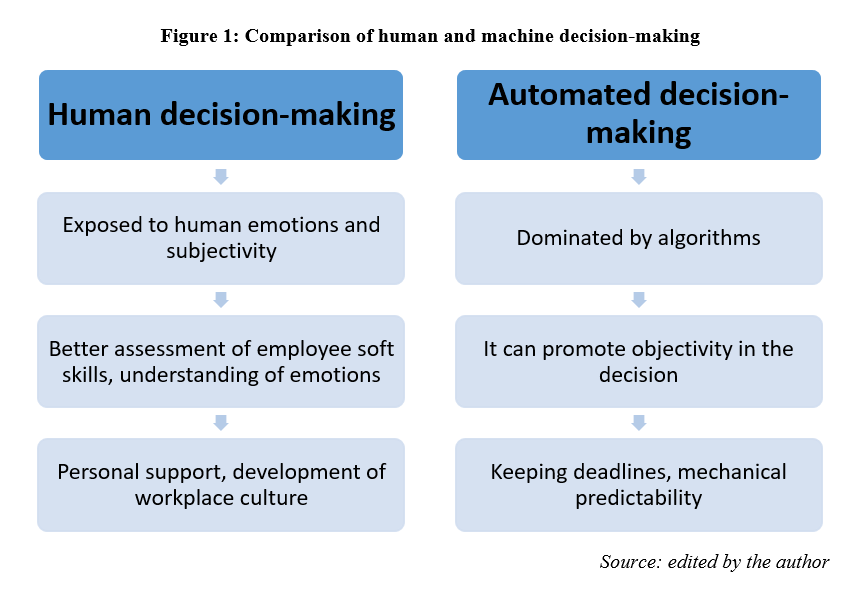
Algorithmic decision-making has a lot of potential, as these systems can be better at meeting deadlines, solving problems and planning cost, while doing faster, more efficient work. However, algorithmic decision-making is not superior to human decision-making in every respect. Human decision-makers are better at assessing subjective factors and employee soft skills (e.g. communication skills, cooperation skills), at understanding emotions, at providing personal support and at developing workplace culture. The use of algorithmic systems also raises a number of legal challenges, which will be discussed at the end of this chapter.
The automated systems described above are not always positively received. An interesting example is the ‘No Robot Bosses Act 2023‘, a US bill that would impose requirements on automated decision-making systems in the workplace, including a ban on the exclusive use of automated decision-making systems.
3. Robotic and AI ‘co-workers’, changing work environment
The increasing use of AI will lead to an increasing ‘coexistence’ of human workers and AI, transforming not only employer decision-making, but also the work and the work environment itself. On the one hand, this may manifest in the form of AI-driven machines or software that workers use to carry out work processes (e.g. translation software, smart factories).
In a 2024 article, IBM compiled the most important potential use cases for AI in business, highlighting how AI can help improve business activity. Use cases include improving customer interaction with real-time AI chatbots and digital assistants; using generative AI to assist in the preparation of various documents; using AI to accelerate certain workflows; and improving cybersecurity, to name just a few examples.
On the other hand, a robotised workforce (industrial or social robots) can emerge alongside the human workforce, leading to the use of collaborative robots, also known as cobots, in the workplace. Collaborative robots (cobots) are designed to work in collaboration with human workers in the same workspace.[8] Cobots are used in several different areas, such as in the healthcare sector (e.g: RoBear), in factories and warehouses, or even Pepper, the frequently used receptionist.
An online article published on Thomasnet.com proposes that everyday applications for cobots include agro-robots that can help pollinate more efficiently, autonomous cleaning robots, restaurant cobots, which lead customers to their seats and serve them, and retail robots that can make coffee or cocktails, or even roast chicken.
Artificial intelligence will not only affect the subjects of the employment relationship, i.e. the employer and the employee, but the work environment itself as well. An interesting, if somewhat futuristic, example of this is work in the metaverse. The metaverse can be described as a ‘3D virtual shared world where all activities can be performed using augmented and virtual reality services’.[9] The metaverse is inseparable from digitalisation. It can be conceived as a new generation of the internet, where users interact in real time through their digital avatars.[10] While early forms of metaverse already exist and are being used, it is important to note that the necessary hardware and software power is not currently available to create the perfect virtual reality imagined by users as metaverse, usually depicted in science fiction.[11]
The movies Matrix and Ready Player One feature examples of ‘perfect’ metaverses, which do not (yet?) exist in reality. Examples of existing, albeit relatively primitive metaverses are Second Life, which is a free 3D virtual world where users can create, interact and chat with others around the world using voice and text, and Roblox, a multiplayer online video game and game development system. It is worth noting that Ariana Grande gave a concert in the metaverse and university graduation ceremonies have been organised there.
Although working in a metaverse is far from widespread, the topic has received a lot of attention, and virtual offices have already started to spring up.
Examples include the Korean Zigbang’ Metaplois and Meta’s (formerly Facebook) Horizon Workrooms. In 2022, Zigbang moved its headquarters to the virtual world, allowing employees to log in from home and then interact with their co-workers’ avatars when they enter the virtual office. Meta has created Horizon Workrooms, an always-on virtual space where employees can work together in unprecedented ways.
4. Certain correlations between AI and labour law
The rise of artificial intelligence poses challenges for many employee entitlements. Although the relationship between AI and (labour) law will be discussed in more detail in a later chapter, it is necessary to address the fundamental nature of the legal challenges that arise.
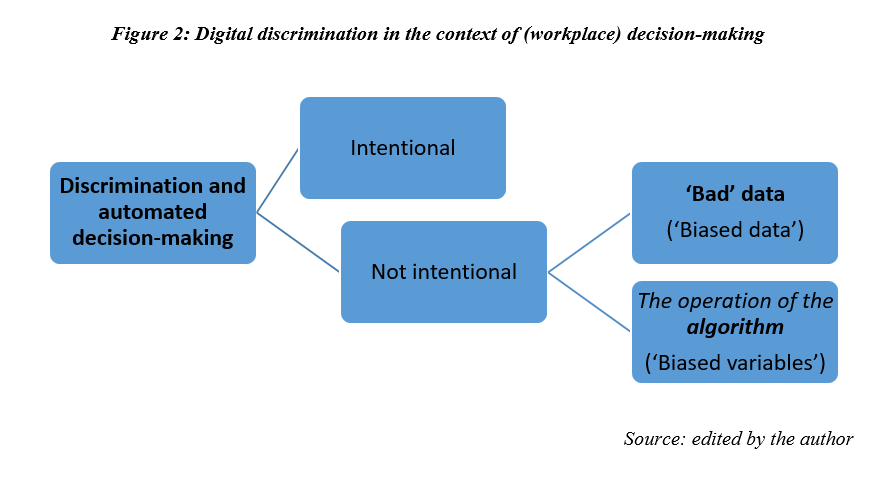
The areas of law particularly concerned include the right to equal treatment, which is of particular importance when automated decision-making systems are used. Equality is one of the most important fundamental values of the EU, which essentially prohibits any unjustified discrimination, in particular discrimination on the basis of the so-called protected characteristics (e.g. gender, race, colour, ethnic or social origin, etc.).[12] While human decision-makers may be influenced unconsciously by certain factors, such as stereotypes and prejudices underlying discrimination, or even by mood and weather, algorithms seem to lack subjectivity and operate in a mechanistic and predictable way. However, a closer look at the issue shows that the human factor cannot be ignored in algorithmic decision-making, either. These decision-making systems are based on data, which come from databases created by people living in a society. Also, the algorithms are programmed by humans.[13] These considerations raise the issue of digital discrimination.
How can an algorithm discriminate in the selection of workers? Survival of the Best Fit is a simulation in English, which you can try what it is like to make a decision as an HR professional and then trust the algorithm to make that decision for you.
One possible case of discrimination seeping into algorithmic decision-making is when the algorithm is trained on ‘bad’ data that inherently reflect discrimination[14], i.e., the algorithm is essentially asked to reproduce an inherently discriminatory human decision.
An example to this is Amazon’s automated selection system. Amazon made an attempt to automate its recruitment process in 2014. After a year, however, the project was stopped because it was found that the system discriminated against female applicants for technical jobs. This was partly because the database used to train the algorithm consisted of CVs of people already successfully employed by the company, the vast majority of whom were male. Not surprisingly, the algorithm concluded that it should also select male applicants.
In another plausible case, the algorithm itself may be the cause of the disadvantage.[15] In the case of autonomous decision systems, the black box phenomenon makes it impossible to find out with absolute certainty how the algorithm makes its decision and what information it uses for that purpose.
The term ‘black box’ refers to the phenomenon where the operation of an AI system is not transparent or understandable to humans, i.e. it is not possible to explain exactly why the system has reached a particular decision. There could be several reasons for this: the algorithm, the training data and the model, i.e. the components of machine learning, can all be a source of opacity.[16]
This may imply that even if the algorithm is programmed to ignore a certain protected feature (e.g. skin colour), it may replace it with another ‘proxy’ feature during machine learning.[17]
For example, if the decision-making system takes into account the distance between the workplace and the place of residence, it may even be the case that the place of residence is used as a proxy for skin colour, if, for example, people of a certain skin colour, which is a protected characteristic, are over-represented among people living in the suburbs.[18]
The operation of AI and algorithmic management relies heavily on the treatment of personal data, making it particularly important to make sure that the right to the protection of personal data is effectively enforced. The protection of personal data essentially refers to the set of rules governing the processing and treatment of personal data relating to the data subject (in this case, the employee).[19]
One of the challenges is the transparency of data processing. Known in data protection law as transparency [Article 5(1)(a) of the GDPR], the term essentially means that the entire process of data processing must be transparent to the outside world. However, the black box phenomenon can call into question the effectiveness of the principle, as the external observer (employer, employee or job applicant) will usually have knowledge only about the decision that the system has made and the data it used for the decision, but not the causal link between the two (i.e. why and how the particular outcome was reached).[20]
The so-called fairness principle [Article 5(1)(a) of the GDPR] implies a moral and ethical attitude beyond mere formal compliance with the law.[21] On the one hand, it is closely linked to the principle of transparency and requires that data subjects (in this case, employees or job applicants) are not misled or deceived in the context of the processing of their personal data. On the other hand, for example in the context of automated decision-making, it also requires that it is unbiased and complies with the requirement of equal treatment.[22]
According to the data minimisation principle [Article 5(1)(c) GDPR], the data processed must be adequate, relevant and limited to what is necessary in relation to the purposes for which they are processed. A fundamental feature of the operation of AI is that it requires access to the largest possible set of data, which is particularly important in the learning phase[23] and for the identification of new and unexpected contexts.[24] This may be in conflict with the principle of data minimisation.
Important health and safety issues, such as accidents at work or increasing workloads may arise in the context of the use of cobots, which may infringe upon the workers’ right to work without endangering their health and safety. These issues are dealt with in detail in a separate chapter.
The use of AI in the workplace (either in employer or employee roles) can have many benefits. It can increase the efficiency, accuracy and speed of processes – but it cannot (yet?) best human employers and employees when considering human, subjective factors. However, the fact that something is technologically possible does not necessarily make it legal. In order to realise the potential of AI, we must not forget the legal challenges associated with its use. This makes it crucial to ensure that the system operates in a secure and lawful way, respecting fundamental rights.
It is also important to clarify that these challenges are not brought about by AI per se (e.g. a human employer can also make discriminatory decisions or can operate a control system that does not respect data privacy) – these are issues that have already been known for a while, but raised with different intensity and requiring increased scrutiny.
Among the possible responses to these challenges, this paper focuses on the solutions offered by legislation. The issue is addressed by current legislation that is not intended to exclusively regulate AI (e.g. the rules on automated decision-making included in the EU General Data Protection Regulation [GDPR]) and legislation specifically addressing AI (e.g. the EU Artificial Intelligence Act) alike. These rules are described in detail below.
A mesterséges intelligencia munkahelyen történő alkalmazása (akár munkáltatói, akár munkavállalói szerepeket tekintve) számos előnnyel járhat. Növelheti a folyamatok hatékonyságát, pontosságát, gyorsaságát – ugyanakkor az emberi, szubjektív tényezők figyelembevétele során (még?) nem körözi le a humán munkáltatókat és munkavállalókat. Attól viszont, hogy valami technológiai szempontból lehetséges, nem feltétlenül lesz jogszerű az alkalmazása. Annak érdekében, hogy a mesterséges intelligenciában rejlő lehetőségeket kiaknázhassuk, nem szabad elfeledkezni a használatához kapcsolódó jogi kihívásokról. Mindez kulcsfontosságúvá teszi a rendszer biztonságos és jogszerű, az alapjogokat tiszteletben tartó működésének megvalósítását.
Fontos azt is tisztázni, hogy ezeket a kihívásokat önmagában nem a mesterséges intelligencia hívta életre (pl.: egy humán munkáltató is képes diszkriminatív döntést hozni, egy humán munkáltató is tud működtetni egy a személyes adatok védelméhez való jogot tiszteletben nem tartó ellenőrzési rendszert) ugyanakkor azokat eltérő intenzitással veti fel, szükségessé téve a kérdéskör fokozott vizsgálatát.
A kihívásokra adható lehetséges válaszok közül jelen anyag a jogi szabályozás által kínált megoldásokra fókuszál. Mind a jelenleg hatályos, de nem kizárólag a mesterséges intelligenciát szabályozó (pl.: az EU általános adatvédelmi rendeletének – GDPR – automatizált döntéshozatalra vonatkozó szabályai), mind pedig a kifejezetten mesterséges intelligenciát érintő jogszabályok (pl.: EU mesterséges intelligencia rendelete) foglalkoznak a kérdéssel. Ezen szabályok részletes bemutatására a későbbiekben kerül sor.
Go to next chapter
Back to the MOOC home page
Recommended reading
- G. Karácsony Gergely: A mesterséges intelligencia által támogatott munkáltatói döntéshozatal adatvédelmi kérdései. Erdélyi Jogélet (2020) 4. szám, 29-37.o. Elérhető: https://www.jogelet.ro/index.php/eje/article/view/66/54 (Letöltés ideje: 2024. 11. 11.)
- Hajdú József: A robotok munkaerőpiaci hatása. Iurisperitus Kiadó, Szeged, 2020.
- Lukács Adrienn: Digitális diszkrimináció és automatizált döntéshozatal, különös tekintettel a munka világára. Miskolci Jogi Szemle 18. évfolyam (2023) 2. szám, 103-117. o. Elérhető: https://ojs.uni-miskolc.hu/index.php/jogiszemle/article/view/2890/2107 (Letöltés ideje: 2024. 11. 11.)
- Mélypataki Gábor: A munka digitalizálódása a munkajogi alapelvek tükrében. Miskolci Jogi Szemle 15. évfolyam (2020) 3. különszám, 29-37. o. Elérhető: https://www.mjsz.uni-miskolc.hu/files/13828/12_mélypatakigábor_tördelt.pdf (Letöltés ideje: 2024. 11. 11.)
References
[1] Valerio De Stefano: “Negotiating the Algorithm”: Automation, Artificial Intelligence, and Labor Protection. Comparative Labor Law & Policy Journal, 41. évfolyam (2019) 1. szám, 15-16. o.
[2] A 29. cikk szerinti Adatvédelmi Munkacsoport: Iránymutatás az automatizált döntéshozatallal és a profilalkotással kapcsolatban a 2016/679 rendelet alkalmazásához, WP251rev.01, 2017, 8. o.
[3] Algorithm Watch: Automated Decision-Making Systems and Discrimination. Understanding causes, recognizing cases, supporting those affected - A guidebook for anti-discrimination counseling, 2022, 5. o. Elérhető: https://algorithmwatch.org/en/wp-content/uploads/2022/06/AutoCheck-Guidebook_ADM_Discrimination_EN-AlgorithmWatch_June_2022.pdf (Letöltés ideje: 2024. 11. 11.)
[4] Markus Langer – Richard N. Landers: The future of artificial intelligence at work: A review on effects of decision automation and augmentation on workers targeted by algorithms and third-party observers, Computers in Human Behavior (2021) 123. szám, 1. o.
[5] G. Karácsony Gergely: A mesterséges intelligencia által támogatott munkáltatói döntéshozatal adatvédelmi kérdései. Erdélyi Jogélet (2020) 4. szám, 34. o.
[6] International Labour Organization–European Commission: The Algorithmic Management of work and its implications in different contexts. Background paper n°9, 2022, 5. o.
[7] G. Karácsony Gergely: A mesterséges intelligencia által támogatott munkáltatói döntéshozatal adatvédelmi kérdései. Erdélyi Jogélet (2020) 4. szám, 30-32. o.
[8] Valerio De Stefano – Simon Taes: Algorithmic Management and Collective Bargaining. ETUI, Foresight Brief, 2021, 4. o.
[9] Muhammet Damar: Metaverse Shape of Your Life for Future: A bibliometric snapshot, Journal of Metaverse, 2021/1. szám, 1. o.
[10] Hyoung-Yong, Choi: Working in the Metaverse: Does Telework in a Metaverse Office Have the Potential to Reduce Population Pressure in Megacities? Evidence from Young Adults in Seoul, South Korea, Sustainability, 2022/14. évf., 4. p.
[11] Sang-Min Park – Young-Gab Kim: A Metaverse: Taxonomy, Components, Applications, and Open Challenges, IEEE Access, 2022/10. 4210. o.
[12] https://youth.europa.eu/get-involved/your-rights-and-inclusion/right-no…
[13] Ságvári Bence: Diszkrimináció, átláthatóság és ellenőrizhetőség. Bevezetés az algoritmusetikába, Replika, (2017) 3. szám, 66. o.
[14] Ságvári Bence: Diszkrimináció, átláthatóság és ellenőrizhetőség. Bevezetés az algoritmusetikába, Replika, (2017) 3. szám, 66. o.
[15] Ságvári Bence: Diszkrimináció, átláthatóság és ellenőrizhetőség. Bevezetés az algoritmusetikába, Replika, (2017) 3. szám, 66. o.
[16] Üveges István: A feketedoboz jelensége és következményei a mesterséges intelligencia alapú technológiákban. Jogászvilág, 2024. május 6. Elérhető: https://jogaszvilag.hu/a-jovo-jogasza/a-feketedoboz-jelensege-es-kovetkezmenyei-a-mesterseges-intelligencia-alapu-technologiakban/ (Letöltés ideje: 2024. 11. 11.)
[17] Robin Allen – Dee Masters: Artificial Intelligence: the right to protection from discrimination caused by algorithms, machine learning and automated decision-making, Europäische Rechtsakademie (ERA) 2019, 590. o.
[18] Ságvári Bence: Diszkrimináció, átláthatóság és ellenőrizhetőség. Bevezetés az algoritmusetikába, Replika, (2017) 3. szám, 72. o.
[19] Lukács Adrienn: Employees’ Right to Privacy and Right to Data Protection on Social Network Sites: with Special Regard to France and Hungary. Iurisperitus Bt., Szeged, 2021, 60. o.
[20] Kollár Gergő: A mesterséges intelligencia alkalmazásának adatvédelmi aggályai a közigazgatásban. Közigazgatási és Infokommunikációs Jogi PhD Tanulmányok (2022) 1. szám, 14-15. o.
[21] Péterfalvi Attila (szerk.): Magyarázat a GDPR-ról. 2021. május 31. időállapotú, 2021. évi Jogtár-formátumú kiadás, 5.1. fejezet
[22] European Parliamentary Research Service, Scientific Foresight Unit (STOA): The impact of the General Data Protection Regulation (GDPR) on artificial intelligence. (PE 641.530 – June 2020), 44-45. o.
[23] Necz Dániel: A mesterséges intelligencia felhasználásával történő adatkezelések egyes sajátos szempontjai. Acta Humana (2022) 3. szám, 96. o.
[24] European Parliamentary Research Service, Scientific Foresight Unit (STOA): The impact of the General Data Protection Regulation (GDPR) on artificial intelligence. (PE 641.530 – June 2020), 47. o.


