

Digital pedagogy at museums for increased learning and active participation

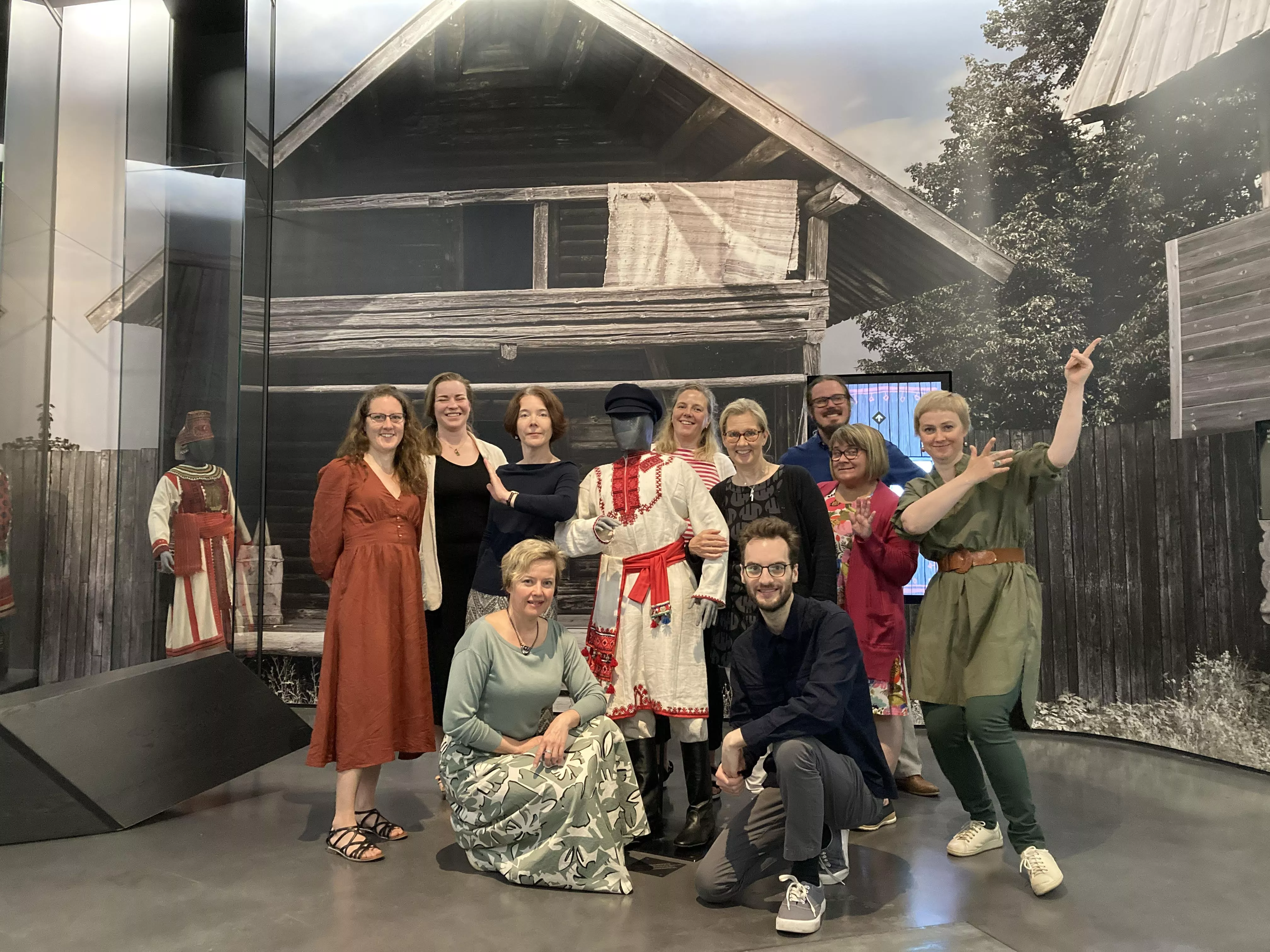
Project group in Digital Solutions for Applied Heritage
How can museums encourage lifelong learning and active participation through the use of digital tools? The Nordic Centre of Heritage Learning and Creativity (NCK) is currently investigating this question in a project funded by Erasmus+, along with stakeholders from Sweden, Finland and Estonia. The project is called Digital Solutions for Applied Heritage – Exploring Transnational Learning Opportunities. Due to the coronavirus pandemic, museums needed to rapidly find digital solutions for outreach, engagement and learning. Many museums produced creative solutions that helped them maintain a relationship with their visitors despite the pandemic. Now that restrictions have been lifted, there is a need to examine what we can learn from these spontaneous solutions and to build something more durable and long term. Many project stakeholders are working on experimentally producing and pilot testing digital or hybrid education programmes. Within the project, we are particularly interested in how digital tools can encourage active participation in what we call transnational learning, i.e. learning that builds bridges across national boundaries, bringing together people from different countries and focusing on themes such as migration, movement and flight.
As part of the project, NCK distributed a questionnaire and conducted follow-up interviews with museums in Sweden, Finland and Estonia. The survey aimed to obtain information about the museums’ digital conversion, which digital solutions have been used to encourage learning and whether, and if so how, they succeeded in making participants active co-creators. Responses were received from 85 museums (37 in Sweden, 31 in Estonia and 17 in Finland). So far, we have conducted long interviews with eight museum employees in the three countries, and more are planned. The questionnaire revealed the most popular tools, such as YouTube for streaming lectures and tours, Zoom/Teams for encouraging dialogue and meetings, and Facebook for marketing via social media. As regards co-creation and active participation, around 50% of the museums work towards this, but primarily targeting schoolchildren and young people. It is comparatively unusual to try to create active participation, via digital tools, in activities that target older people or recent immigrants – there, digital learning appears to be more one directional. There is thus potential for much greater digital pedagogy at museums, not least associated with important societal issues such as lifelong learning, active ageing and integration. In other words, digital pedagogy that is linked to informal learning outside of schools.
There were many suggestions worth considering as regards digital learning. Some of them are:
-
Even though learning is done digitally, many different senses can be stimulated: touch, smell, hearing, vision, taste. Shorts can be recorded in which different sounds, like traffic, animals or music, have an important role in learning. Physical objects can be incorporated. It is probable that all five senses will be increasingly important in future digital learning, as highlighted by museum researcher Sandro Debono: “Taking the five senses as the essential elements of the ideal museum experience, the authenticity of digital soundscapes, or lost voices recovered from distant histories, can be as authentic as a painting hanging in a physical museum space.” (Debono 2021: 162)
-
The body can also play a role in communication and interaction (e.g. using movements such as thumbs up or getting up from a chair) even though the person is sitting at the computer. This increases the feeling of being present and can also create communication and interaction with people who do not even speak the same language, which has the potential to lead to more meetings across boundaries.
-
Try to work with live experiences where possible, as this enables interaction and a sense of influence. Do not be afraid of spontaneity and things that are unplanned. Live experiences can be supplemented with video and sound.
-
Work as closely as possible with the intended audience and provide inspiration for finding digital or hybrid formats relevant to them. One inspiring example is the Swedish Museum of Natural History’s close dialogue with teachers on producing education programmes, where they have regular contact with teachers via an active Facebook group that continually tests and provides feedback on formats.
-
Inspiration can come from many places. Conferences and networks are important, but do not forget to find in the audiences you want to reach out to and influence.
-
It does not have to be complicated! Simple solutions for digital pedagogy can also work excellently.
The above are just some of the insights we have gained through our survey. More are on the way, as part of the handbook in digital pedagogy for museum educators that is being produced by the project.
After restrictions were lifted, we observed concern among museum educators about the role of digital resources in learning, now many people appear to be digitally fatigued. I believe it may be beneficial to look up and broaden our perspectives. Sandro Debano convincingly writes: “The rise of the millennial generation, often referred to as ‘digital natives’ due to their early and elevated usage of and familiarity with the digital world, points to the potentially sustained and rapid growth of digital experiences within the museum ecosystem.” (Debano 2021: 161) Additionally, digital media will make it possible to reach out to people who would otherwise have been missed, which also provides potential for accessing what could be a global audience. For this, we need to think creatively, as well as with a long-term perspective, which is currently not institutionalised at many of the museums that participated in our survey, something confirmed by other studies at European, American and global levels (as described in ICOM 2020, Knights Foundation 2020; American Alliance of Museums 2021; NEMO 2021). One priority for museums should therefore be to produce sustainable, long-term and forward-looking (Wollentz 2021) strategies for digital learning.
Gustav Wollentz, PhD
Researcher and project leader at Nordiskt centrum för kulturarvspedagogik
Referenser
American Alliance of Museums. 2021. Trendswatch- Navigating a disrupted Future. https://www.aam-us.org/wp-content/uploads/2021/02/2021_TrendsWatch_V1_f…
Debono, Sandro. 2021. Thinking Phygital: A Museological Framework of Predictive Futures, Museum International,73:3-4, 156-167, DOI: 10.1080/13500775.2021.2016287
ICOM. 2020. Museums, museum professionals and COVID-19. https://icom.museum/wp-content/uploads/2020/05/Report-Museums-and-COVID-19.pdf
Knights Foundation. 2020. Digital Readyness and Innovation in Museums. https://knightfoundation.org/wp-content/uploads/2020/10/Digital-Readine…
NEMO. 2021. Follow-up survey on the impact of the COVID-19 pandemic on museums in Europe. Final Report. https://www.ne-mo.org/fileadmin/Dateien/public/NEMO_documents/NEMO_COVI…
Wollentz, Gustav. 2021. Hur framtidsmedvetna är svenska länsmuseer?. UNESCO Chair on Heritage Futures,Linnéuniversitetet.
Kommentar


Sensoryczna edukacja cyfrowa
Muzeum zawsze było miejscem idealnym do edukacji sensorycznej. Pomysł robienia tego wirtualnie wykorzystywany jest też w Polsce. Na przykład w Muzeum Warszawskiej Pragi w ramach wystawy zorganizowanej w 2018 roku z okazji 90 urodzin stołecznego ZOO: https://muzeumpragi.pl/wystawa/90-urodziny-warszawskiego-zoo/

A sztorikocka…
A sztorikocka múzeumandragógiai használata, amelyről az Epale Magyarország honlapja is beszámolt, jó példa a múzeumi didaktikai fejlesztésére. A cikk nekem újdonság a digitpedo ilyenfajta használatáról.


Długoterminowe strategie…
Długoterminowe strategie edukacji cyfrowej tworzone przez muzea są konieczne, nie tylko dla tego, że grożą nam powtórki z pandemii Covid-19. Należy je opracowywać również pod kątem kryzysu energetycznego, którego odsłonę obserwujemy w związku z wojną w Ukrainie. Bez opracowania rozwiązań, które wezmą pod uwagę zagrożenia wynikające z ograniczenia dostępu do odnawialnych źródeł energii, trudno będzie tworzyć sensowne scenariusze przyszłości dla edukacji cyfrowej.